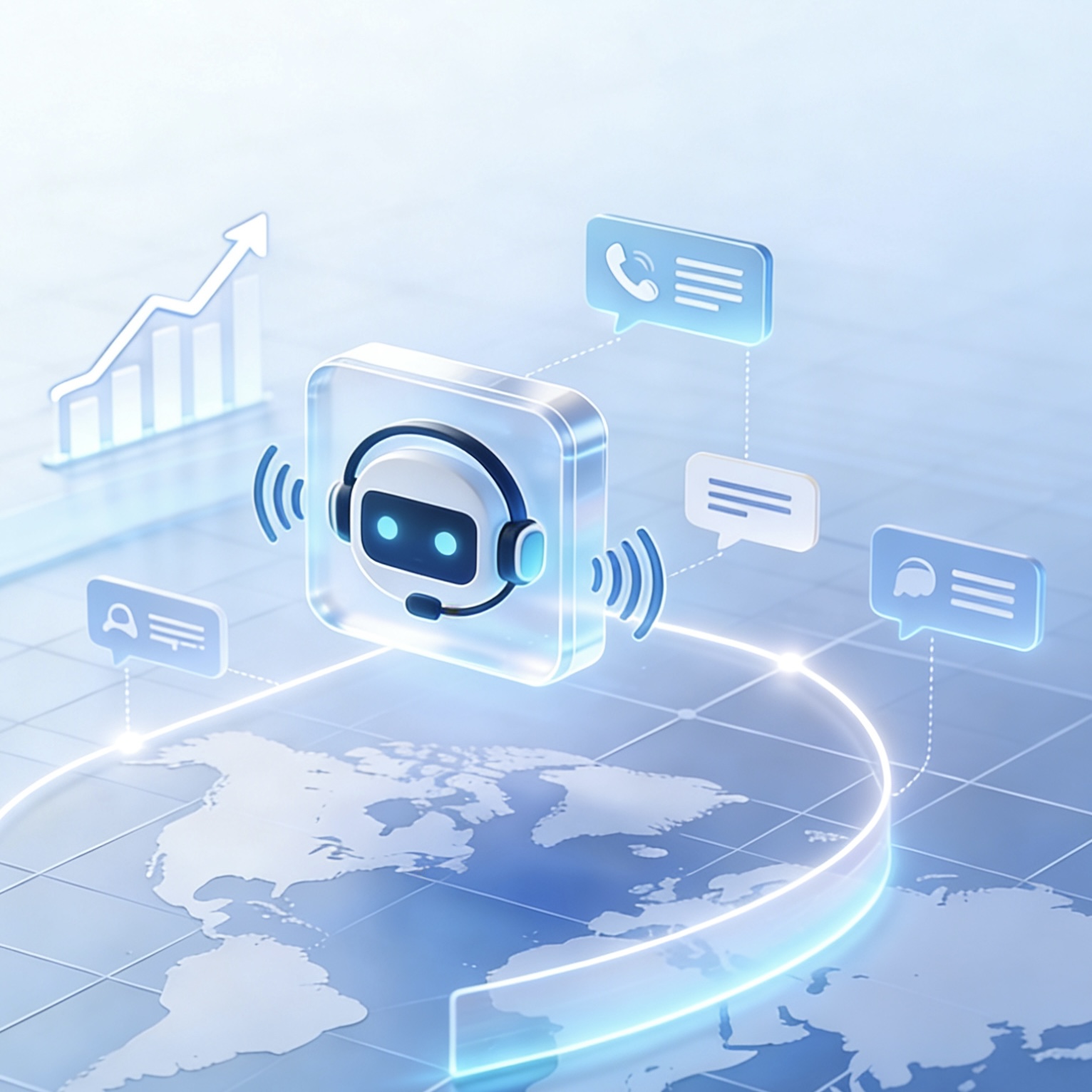
Intelligent Voice Bot Solution How AI Scales Voice Operations in Global Customer Service
In many overseas markets, customers will still choose to make a call when the problem becomes urgent or has a large impact. Voice remains one of the most trusted channels in customer service, especially in service scenarios that require immediate feedback, clear explanation or compliance process ation.
But the reality is that the customer service team is under increasing pressure. The volume of calls continues to grow, multilingual services have gradually become the norm, and the cost of manpower in different regions is rising. The traditional call center model is no longer able to support the service needs of cross-regions and cross-time zones.
It is against this background that intelligent voice bot solution is adopted by more and more enterprises. Through AI voice interaction and structured call process, enterprises can automate high-frequency voice communication scenarios, so that manual customer service can focus on more complex and higher-value problems. This article will discuss the practical value of intelligent voice bot in the modern overseas customer service system in combination with Instadesk Voice Bot.
I. Why is Voice still important in overseas customer service?
Although online chat, messaging and other channels are constantly developing, Voice is still irreplaceable in many service scenarios. Customers usually choose to make a call in the following cases:
• Need to solve the problem immediately
• Involve complex or sensitive information
• The service process needs to be clearly ed.
In North America, Southeast Asia and other markets, Voice is widely used in customer consultation, appointment ation, payment reminder and after-sales return visits.
But at the same time, the Voice service also puts forward higher requirements for response speed, staffing and training. Simply relying on increasing manpower will soon encounter cost and management bottlenecks.
II. Challenges faced by the traditional Voice customer service model
Many enterprises still adopt the call center model with manual seating as the core, but with the expansion of scale, the problems gradually emerge:
• Operating costs continue to rise: the human and training costs of multilingual customer service teams are increasing.
• Limited expansion capacity: it is easy to queue, miss or delay response during peak hours.
• Inconsistent service quality: There are differences in communication methods and processing results between different customer service personnel.
• A large number of repetitive calls: verification, reminder and notification calls take up a lot of manual time
When the business has reached a certain stage, "recrering more people" can no longer fundamentally solve the problem.
III. What is Intelligent Voice Bot Solution?
Intelligent voice bot solution realizes a voice interaction experience closer to real people through AI voice recognition and natural language understanding.
Unlike traditional IVR, intelligent voice bot can:
• Understand natural language expressions
• Dynamically adjust the communication method according to the content of the dialogue
• Complete multiple rounds of interaction according to the business process
• Seamlessly transfer manual customer service when needed
In practical applications, voice bot is usually responsible for handling structured and high-frequency voice scenarios as the first contact layer, and handing up complex problems to manual customer service for follow-up.
IV. The core competence of Intelligent Voice Bot
A mature intelligent voice bot solution usually has the following capabilities:
1. Natural voice interaction
Customers don't need to press the button, and they can complete the communication through dialogue.
2. Configurable call process
Support a variety of scenarios such as identity verification, reminder notification, investigation and return visit.
3. Intelligent transfer mechanism
According to the customer's intention and rules, transfer the call to manual customer service.
4. Real-time data collection
Automatically record the key information in the call.
5. Multi-language support
Meet the language service needs of different countries and regions.
These capabilities enable voice automation to truly integrate into the business process of the enterprise, instead of staying at the simple response level.
V. Typical application scenarios of Intelligent Voice Bot
In actual business, intelligent voice bot is often used for:
• Outbound call notification and reminder
• Customer information ation
• Large-scale return visit mission
• Preliminary voice diversion
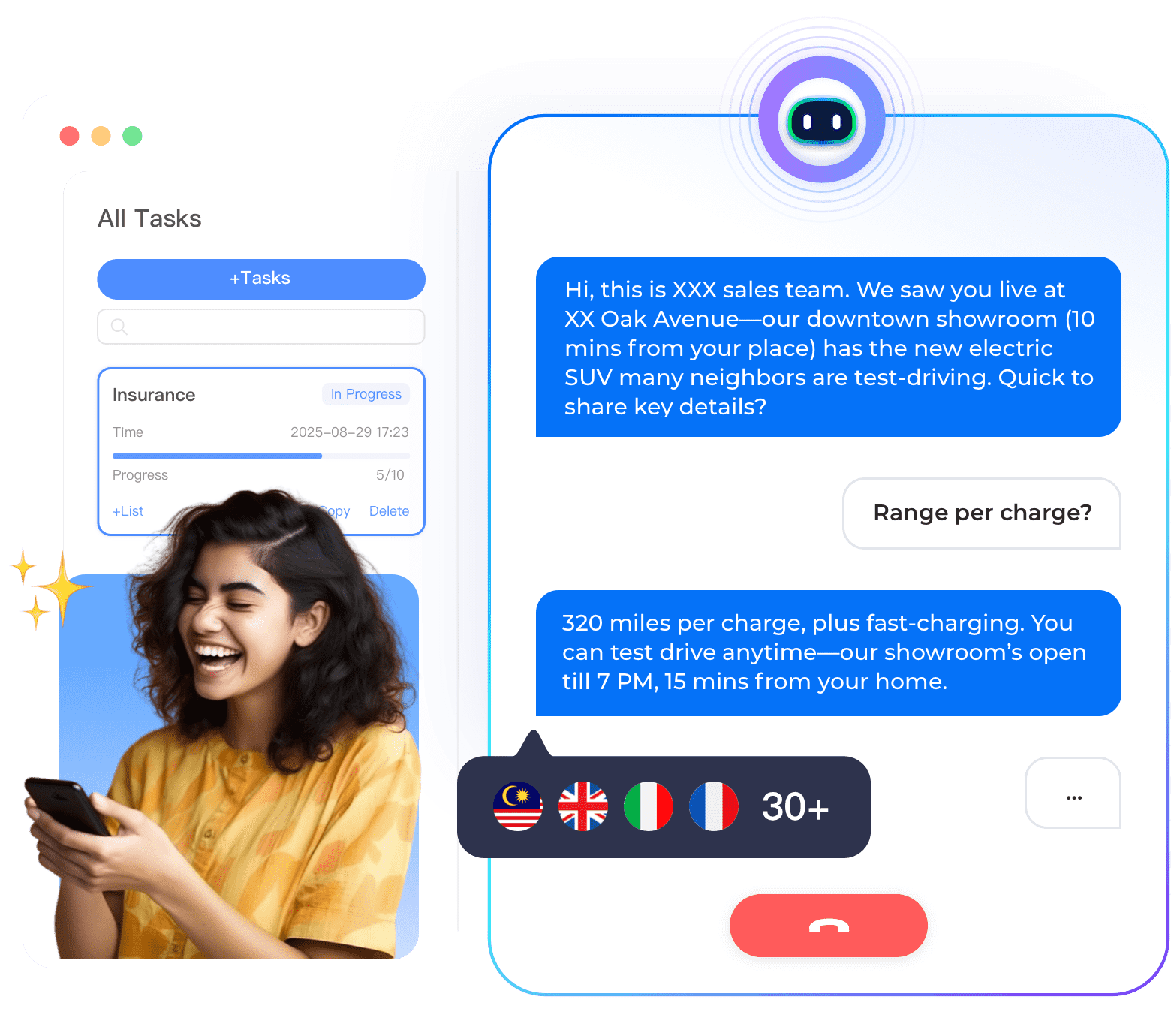
For example, in the outbound scenario, enterprises can use Instadesk Voice Bot to automatically complete high-frequency calls and transfer to manual customer service when identifying that the customer has further needs, without sacrificing the service experience while ensuring efficiency.
VI. The actual value of Instadesk Voice Bot
As part of the overall customer service system, Instadesk Voice Bot helps enterprises build scalable Voice service capabilities, including:
• Outbound task automation
• Structured call handling
• Multilingual voice support
• Integration with ticketing and customer service systems
In the call center environment, Instadesk Voice Bot usually works with manual customer service to undertake standardized, high-frequency voice tasks instead of replacing manual roles, so as to help teams maintain stable and consistent service quality in high call volume scenarios. .
Conclusion
With the globalization and large-scale development of customer service, Voice is still an important channel that cannot be ignored. The traditional manual-based call center model is difficult to achieve a balance between cost, quality and scalability.
Intelligent voice bot solution provides a more sustainable path for enterprises. By automatically processing structured voice scenarios and introducing manual support at key nodes, enterprises can continue to provide a stable Voice service experience without significantly increasing costs.
Solutions such as Instadesk Voice Bot are gradually becoming an important part of the modern overseas customer service system.
Share This Article



Issac
Omnichannel Digital Operations: Driving Traffic Growth & Deepening User Value
You may also like

AI Outbound VoiceBot vs. Manual Outbound Calls – Business Priorities for 2026
The debate between AI-driven and manual outbound calling has intensified. Manual teams are expensive, limited by human hours, and inconsistent. An ai outbound voicebot offers a scalable, intelligent, always‑on alternative based on real product features from Instadesk.


Instadesk Inbound VoiceBot: 24/7 Answer in Seconds, 80% of Issues Resolved Automatically
Instadesk Inbound VoiceBot is an enterprise‑grade intelligent voice customer service bot. It answers calls 24/7 within seconds – near‑zero queue rates. It supports multi‑language natural conversation with low error rate and interruption handling. It deeply integrates with CRM/ERP/order systems to check orders, create tickets, and initiate refunds during the call. Its dynamic knowledge base resolves ≥80% of common issues. It handles multi‑turn task‑oriented conversations (forms, appointments, repairs). When human handoff is needed, it pushes conversation summaries and customer profiles – no repetition required. Suitable for finance, retail, logistics, government, and more.


Multilingual Voice Bot vs Monolingual:A Guide for Energy Companies
Energy companies serve diverse customer bases that speak multiple languages.A monolingual voice bot supports only one language,forcing non-native speakers to struggle or seek human agents.A multilingual voice bot can understand and respond in several languages,improving customer experience and reducing agent workload.This article compares multilingual and monolingual voice bots,highlights the benefits of multilingual capabilities for energy utilities,and explains how Instadesk’s platform enables cost-effective multilingual deployment.
Get Started in Minutes. Experience the Difference.




WhatsApp Us Now !